Cut Vertices and Bridges
Related reading: Biconnected Component
For more rigorous definitions of cut vertices and bridges, refer to Graph Theory Concepts.
Cut Vertex
For an undirected graph, if removing a vertex increases the number of connected components in the graph, then that vertex is a cut vertex (also known as an articulation point).
Procedure
If we try to delete each vertex and check the connectivity of the graph, the complexity would be very high. Therefore, we introduce a commonly used algorithm: Tarjan.
First, consider the following graph:
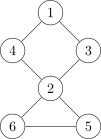
It is easy to see that vertex 2 is a cut vertex, and it is the only one in this graph.
First, we assign timestamps (the order of visitation) according to the DFS order.
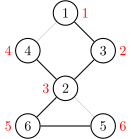
This information is stored in an array called dfn.
We also need another array low, which stores the smallest timestamp reachable without passing through its parent.
For example, low[2] is 1, and low[5] and low[6] are 3.
Then we start DFS. The criterion for determining whether a vertex is a cut vertex is: For a vertex \(u\), if there exists at least one vertex \(v\) (a child of \(u\)) such that \(low_v \geq dfn_u\), meaning \(v\) cannot reach an ancestor, then \(u\) is a cut vertex.
This criterion does not apply to the starting point of the search, which requires special consideration: If the starting point is not a cut vertex, then other paths can also reach all nodes, meaning the starting point only "searches downward once," i.e., it has only one child in the search tree. If the starting point has two or more children in the search tree, then it must be a cut vertex (imagine starting the search from vertex 2 in the above graph; the search tree should have two children: 3 or 4, and 5 or 6). If it has only one child, removing it will have no effect. For example, in the graph below, a cycle is formed.
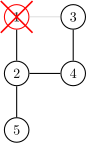
When visiting the children of vertex 1, suppose we first DFS to vertex 2, mark it as visited, then recursively go down to vertex 4, which then goes to vertex 3. During backtracking, we find that vertex 3 has already been visited, so it is not a cut vertex.
The pseudocode for updating low is as follows:
Example
Luogu P3388 【Template】Cut Vertex (Articulation Point)
Example Code
1 2 3 4 5 6 7 8 9 10 11 12 13 14 15 16 17 18 19 20 21 22 23 24 25 26 27 28 29 30 31 32 33 34 35 36 37 38 39 40 41 42 43 44 45 46 47 48 49 50 51 52 53 54 55 56 57 58 | |
Bridge (Without Multiple Edges)
Similar to cut vertices, these are called bridges.
For an undirected graph, if removing an edge increases the number of connected components in the graph, then that edge is called a bridge or cut edge. More rigorously, given a connected graph \(G=\{V,E\}\), \(e\) is one of its edges (i.e., \(e \in E\)). If \(G-e\) is disconnected, then edge \(e\) is a cut edge (bridge) of graph \(G\).
For example, in the graph below,
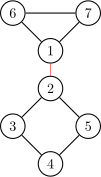
the red edge is a bridge.
Procedure
It is similar to finding cut vertices, with only one change: the condition becomes \(low_v>dfn_u\), and there is no need to consider the root node.
Bridges are independent of whether a node is the root. When finding cut vertices, we considered that vertex \(v\) cannot reach an ancestor (including the parent) without passing through its parent \(u\), so vertex \(u\) is a cut vertex. If \(low_v=dfn_u\), it means \(v\) can still reach the parent. If vertex \(v\) cannot reach an ancestor and has no other path back to the parent, then the edge \(u-v\) is a bridge.
Implementation
The following code finds bridges in an undirected graph without multiple edges. When isbridge[x] is true, (father[x],x) is a bridge.
1 2 3 4 5 6 7 8 9 10 11 12 13 14 15 16 17 18 19 20 21 22 | |
1 2 3 4 5 6 7 8 9 10 11 12 13 14 15 16 17 18 19 20 21 22 23 | |
Bridge (With Multiple Edges)
However, the above method for graphs without multiple edges fails for undirected graphs with multiple edges.
Because there may be more than one edge between two nodes, none of these edges will be bridges.
Procedure
One approach is to change the parameter fa to the ID of the edge just traversed (each edge has a unique ID), i.e., change "do not update using the parent node" to "do not update using the incoming edge."
Another simpler approach is to set a flag to indicate whether an edge to the parent has already been traversed. After setting the flag, when visiting the parent again, update normally.
The following code finds bridges in an undirected graph that may have multiple edges.
1 2 3 4 5 6 7 8 9 10 11 12 13 14 15 16 17 18 19 20 21 22 23 24 25 26 | |
Practice Problems
- P3388 【Template】Cut Vertex (Articulation Point)
- POJ2117 Electricity
- HDU4738 Caocao's Bridges
- HDU2460 Network
- POJ1523 SPF
The Tarjan algorithm has many other applications, such as finding strongly connected components, graph condensation, and solving 2-SAT problems.
本页面最近更新:,更新历史
发现错误?想一起完善? 在 GitHub 上编辑此页!
本页面贡献者:OI-wiki
本页面的全部内容在 CC BY-SA 4.0 和 SATA 协议之条款下提供,附加条款亦可能应用