Since the time complexity of HLD is \(O(n\log^2 n)\), while the well-known LCT (Link-Cut Tree) has a time complexity of \(O(n\log n)\) but with a large constant factor, it might even be slower than HLD. So, is there a method that is both \(O(n\log n)\) and has a relatively small constant factor? This is where the Global Balanced Binary Tree (GBST) comes in.
The Global Balanced Binary Tree is essentially a forest of binary trees, where each binary tree maintains a heavy path. However, the binary trees in this forest are interconnected: the root of each binary tree is linked to the parent of the top node of its corresponding heavy path, similar to LCT. But unlike LCT, the GBST is a static tree—its structure does not change after construction.
The Global Balanced Binary Tree is a data structure that can handle path modifications/queries on trees, achieving:
\(O(\log n)\) for modifying an entire path.
\(O(\log n)\) for querying an entire path.
\(O(\log n)\) for operations like finding the lowest common ancestor, subtree modifications, and subtree queries. These complexities are the same as in heavy-light decomposition.
Key Properties
The Global Balanced Binary Tree consists of many binary trees connected by light edges. Each binary tree maintains a heavy path from the original tree, with its in-order traversal corresponding to the monotonically increasing depth order along that heavy path. Each node appears in exactly one binary tree.
Edges are classified as heavy edges and light edges. Heavy edges are those within a binary tree, maintained like a normal binary tree by recording left child, right child, and parent node. Light edges connect the root of a binary tree to the parent of the top node of its corresponding heavy path. Light edges are maintained with "parent recognition only," meaning a child can access its parent but not vice versa. Note that edges in the GBST do not correspond directly to edges in the original tree.
Including both heavy and light edges, the height of the Global Balanced Binary Tree is \(O(\log n)\). This property ensures the time complexity of the GBST.
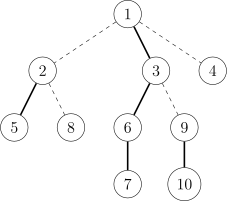
Below is an example of constructing a Global Balanced Binary Tree. The first diagram is the original tree with node 1 as the root. Solid lines represent heavy edges.
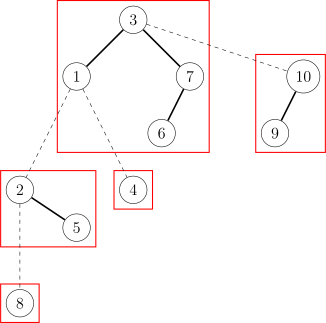
The second diagram shows the constructed Global Balanced Binary Tree. Dashed lines are light edges, solid lines are heavy edges, and each binary tree is indicated by a red circle.
Construction
First, perform a DFS to find the heavy son of each node, just like in standard heavy-light decomposition. Then, starting from the root, identify the heavy path containing the root. Recursively build trees for the light sons of nodes on this path and connect them with light edges. Next, construct a binary tree for the nodes on the heavy path. Store the nodes of the heavy path in an array and compute for each node the sum of the subtree sizes of its light sons plus one (i.e., the contribution of the node itself). Then, find the weighted midpoint of this heavy path based on these values, use it as the root of the binary tree, recursively build the left and right subtrees, and connect them with heavy edges.
std::vector<int>G[N];intn,fa[N],son[N],sz[N];voiddfsS(intu){sz[u]=1;for(intv:G[u]){dfsS(v);sz[u]+=sz[v];if(sz[v]>sz[son[u]])son[u]=v;}}intb[N],bs[N],l[N],r[N],f[N],ss[N];// Build a binary tree for points in b[bl, br) and return the rootintcbuild(intbl,intbr){intx=bl,y=br;while(y-x>1){intmid=(x+y)>>1;if(2*(bs[mid]-bs[bl])<=bs[br]-bs[bl])x=mid;elsey=mid;}// Binary search to find the weighted midpoint according to bsy=b[x];ss[y]=br-bl;// ss: size of the heavy subtree in the binary treeif(bl<x){l[y]=cbuild(bl,x);f[l[y]]=y;}if(x+1<br){r[y]=cbuild(x+1,br);f[r[y]]=y;}returny;}intbuild(intx){inty=x;dofor(intv:G[y])if(v!=son[y])f[build(v)]=y;// Recursively build trees and connect light edges.// Note: connect from the root of the binary tree, not from the son.while(y=son[y]);y=0;do{b[y++]=x;// Store nodes on the heavy pathbs[y]=bs[y-1]+sz[x]-sz[son[x]];// bs: sum of light son sizes + 1, prefix sum}while(x=son[x]);returncbuild(0,y);}
From the code, we can see the construction time complexity is \(O(n\log n)\). Next, we can prove the tree height is \(O(\log n)\): consider jumping from any node to the root via parent pointers. Jumping a light edge corresponds to moving to another heavy path in the original tree; by the properties of heavy-light decomposition, there are at most \(O(\log n)\) light edge jumps. Since the root of each binary tree is chosen as the weighted midpoint considering light sons, jumping a heavy edge at least doubles the total size including light sons, so there are also at most \(O(\log n)\) heavy edge jumps. Thus, the overall tree height is \(O(\log n)\).
Queries
The above covers the construction of the Global Balanced Binary Tree. The remaining operations for path modification and query are relatively straightforward. Starting from the node to be operated on, keep jumping to the root. Operating on all nodes on the same heavy path with depth less than the target node essentially corresponds to operating on all nodes to the left of the target node in the binary tree of that heavy path. These operations can be decomposed into a series of subtree operations, similar to maintaining a normal binary tree, involving maintaining subtree sums and applying subtree tags. In this process, permanent marking is used. Alternatively, one could use pushdown to propagate tags and pushup to maintain subtree sums, but this might be more complex because typically binary tree operations are top-down, whereas here the jump path must be determined first before pushing down from top to bottom, which could lead to a larger constant factor.
// a: subtree addition tag// s: subtree sum (excluding addition tags)inta[N],s[N];voidadd(intx){boolt=true;intz=0;while(x){s[x]+=z;if(t){a[x]++;if(r[x])a[r[x]]--;z+=1+ss[l[x]];s[x]-=ss[r[x]];}t=(x!=l[f[x]]);if(t&&x!=r[f[x]])z=0;// Clear when skipping a light edgex=f[x];}}intquery(intx){intret=0;boolt=true;intz=0;while(x){if(t){ret+=s[x]-s[r[x]];ret-=1ll*ss[r[x]]*a[r[x]];z+=1+ss[l[x]];}ret+=1ll*z*a[x];t=(x!=l[f[x]]);if(t&&x!=r[f[x]])z=0;// Clear when skipping a light edgex=f[x];}returnret;}
Additionally, for subtree operations, which involve light sons, one needs to maintain subtree sums and tags including light sons. This can be practiced with "P3384【Template】Heavy-Light Decomposition".
#include<algorithm>#include<cstdio>#include<cstring>constexprintMAXN=1000000;constexprintMAXM=3000000;constexprintINF=0x3FFFFFFF;usingnamespacestd;structedge{intto;edge*nxt;}edges[MAXN*2+5];edge*ncnt=&edges[0],*Adj[MAXN+5];intn,m;structMatrix{intM[2][2];Matrixoperator*(constMatrix&B)const{staticMatrixret;for(inti=0;i<2;i++)for(intj=0;j<2;j++){ret.M[i][j]=-INF;for(intk=0;k<2;k++)ret.M[i][j]=max(ret.M[i][j],M[i][k]+B.M[k][j]);}returnret;}}matr1[MAXN+5],matr2[MAXN+5];// Each node maintains two matricesintroot;intw[MAXN+5],dep[MAXN+5],son[MAXN+5],siz[MAXN+5],lsiz[MAXN+5];intg[MAXN+5][2],f[MAXN+5][2],trfa[MAXN+5],bstch[MAXN+5][2];intstk[MAXN+5],tp;boolvis[MAXN+5];voidAddEdge(intu,intv){edge*p=++ncnt;p->to=v;p->nxt=Adj[u];Adj[u]=p;edge*q=++ncnt;q->to=u;q->nxt=Adj[v];Adj[v]=q;}voidDFS(intu,intfa){siz[u]=1;for(edge*p=Adj[u];p!=NULL;p=p->nxt){intv=p->to;if(v==fa)continue;dep[v]=dep[u]+1;DFS(v,u);siz[u]+=siz[v];if(!son[u]||siz[son[u]]<siz[v])son[u]=v;}lsiz[u]=siz[u]-siz[son[u]];// Sum of light son sizes + 1}voidDFS2(intu,intfa){f[u][1]=w[u],f[u][0]=0;g[u][1]=w[u],g[u][0]=0;if(son[u]){DFS2(son[u],u);f[u][0]+=max(f[son[u]][0],f[son[u]][1]);f[u][1]+=f[son[u]][0];}for(edge*p=Adj[u];p!=NULL;p=p->nxt){intv=p->to;if(v==fa||v==son[u])continue;DFS2(v,u);f[u][0]+=max(f[v][0],f[v][1]);// f[][] is the normal DP arrayf[u][1]+=f[v][0];g[u][0]+=max(f[v][0],f[v][1]);// g[][] only includes the node itself and light sonsg[u][1]+=f[v][0];}}voidPushUp(intu){matr2[u]=matr1[u];// matr1 is the node's own info plus light sons, matr2 is interval infoif(bstch[u][0])matr2[u]=matr2[bstch[u][0]]*matr2[u];// Note the direction of multiplication, but this may vary if matrix multiplication is defined differentlyif(bstch[u][1])matr2[u]=matr2[u]*matr2[bstch[u][1]];}intgetmx2(intu){returnmax(matr2[u].M[0][0],matr2[u].M[0][1]);}intgetmx1(intu){returnmax(getmx2(u),matr2[u].M[1][0]);}intSBuild(intl,intr){if(l>r)return0;inttot=0;for(inti=l;i<=r;i++)tot+=lsiz[stk[i]];for(inti=l,sumn=lsiz[stk[l]];i<=r;i++,sumn+=lsiz[stk[i]])if(sumn*2>=tot)// Found the centroid{intlch=SBuild(l,i-1),rch=SBuild(i+1,r);bstch[stk[i]][0]=lch;bstch[stk[i]][1]=rch;trfa[lch]=trfa[rch]=stk[i];PushUp(stk[i]);// Aggregate interval informationreturnstk[i];}return0;}intBuild(intu){for(intpos=u;pos;pos=son[pos])vis[pos]=true;for(intpos=u;pos;pos=son[pos])for(edge*p=Adj[pos];p!=NULL;p=p->nxt)if(!vis[p->to])// It's a light son{intv=p->to,ret=Build(v);trfa[ret]=pos;// Connect the light son's treefa[]}tp=0;for(intpos=u;pos;pos=son[pos])stk[++tp]=pos;// Extract the heavy pathintret=SBuild(1,tp);// Perform SBuild on the heavy path (I guess Special Build?)returnret;// Return the root of the binary tree for this heavy path}voidModify(intu,intval){matr1[u].M[1][0]+=val-w[u];w[u]=val;for(intpos=u;pos;pos=trfa[pos])if(trfa[pos]&&bstch[trfa[pos]][0]!=pos&&bstch[trfa[pos]][1]!=pos){matr1[trfa[pos]].M[0][0]-=getmx1(pos);matr1[trfa[pos]].M[0][1]=matr1[trfa[pos]].M[0][0];matr1[trfa[pos]].M[1][0]-=getmx2(pos);PushUp(pos);matr1[trfa[pos]].M[0][0]+=getmx1(pos);matr1[trfa[pos]].M[0][1]=matr1[trfa[pos]].M[0][0];matr1[trfa[pos]].M[1][0]+=getmx2(pos);}elsePushUp(pos);}intread(){intret=0,f=1;charc=0;while(c<'0'||c>'9'){c=getchar();if(c=='-')f=-f;}ret=10*ret+c-'0';while(true){c=getchar();if(c<'0'||c>'9')break;ret=10*ret+c-'0';}returnret*f;}voidprint(intx){if(x==0)return;print(x/10);putchar(x%10+'0');}intmain(){scanf("%d %d",&n,&m);for(inti=1;i<=n;i++)w[i]=read();intu,v;for(inti=1;i<n;i++){u=read(),v=read();AddEdge(u,v);}DFS(1,-1);// Find heavy sonsDFS2(1,-1);// Compute initial DP values; can also be done inside Build(), but this way aligns with HLD stylefor(inti=1;i<=n;i++){matr1[i].M[0][0]=matr1[i].M[0][1]=g[i][0];matr1[i].M[1][0]=g[i][1],matr1[i].M[1][1]=-INF;// Initialize matrices}root=Build(1);// root is the centroid of the heavy path containing the rootintlastans=0;for(inti=1;i<=m;i++){u=read(),v=read();u^=lastans;// Force onlineModify(u,v);lastans=getmx1(root);// Directly get the valueif(lastans==0)putchar('0');elseprint(lastans);putchar('\n');}return0;}