Triangulation
In geometry, triangulation refers to subdividing planar objects into triangles, and by extension, subdividing higher-dimensional geometric objects into simplices. For a given set of points, there are many triangulations, such as:
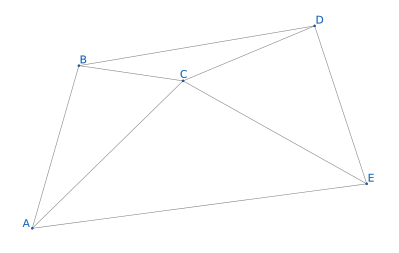
In OI, triangulation mainly refers to perfect triangulation in two-dimensional geometry (2D Delaunay triangulation, abbreviated as DT).
Delaunay Triangulation
Definition
In mathematics and computational geometry, for a given discrete point set \(P\) in the plane, its Delaunay triangulation DT(\(P\)) satisfies:
- Empty circle property: DT(\(P\)) is unique (no four points are cocircular). In DT(\(P\)), the circumcircle of any triangle contains no other points.
- Maximizing the minimum angle: Among all possible triangulations of point set \(P\), DT(\(P\)) maximizes the minimum angle of the triangles formed. In this sense, DT(\(P\)) is the most regular triangulation. Specifically, for two adjacent triangles forming a convex quadrilateral, swapping the diagonal does not increase the minimum of the six interior angles of the two triangles.
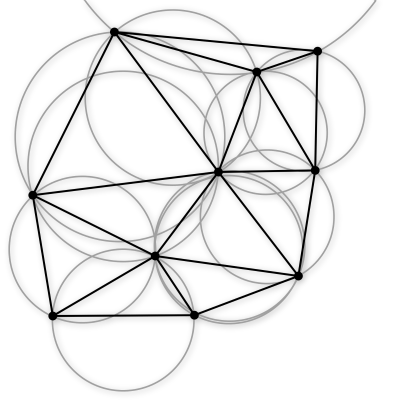
Properties
- Closest: Triangles are formed by the three closest points, and all segments (triangle edges) do not intersect.
- Uniqueness: Regardless of where construction starts, the final result is consistent (no four points in the set are cocircular).
- Optimality: If the diagonal of any convex quadrilateral formed by two adjacent triangles can be swapped, then the minimum angle among the six interior angles of the two triangles does not change.
- Most regular: If the minimum angles of each triangle in the triangulation are sorted in ascending order, the Delaunay triangulation yields the largest sequence.
- Locality: Adding, deleting, or moving a vertex only affects nearby triangles.
- Convex hull boundary: The outermost boundary of the triangulation forms a convex polygon hull.
Divide-and-Conquer Algorithm for Constructing DT
There are many algorithms for constructing DT. Among \(O(n \log n)\) construction algorithms, the divide-and-conquer algorithm is the easiest to understand and implement.
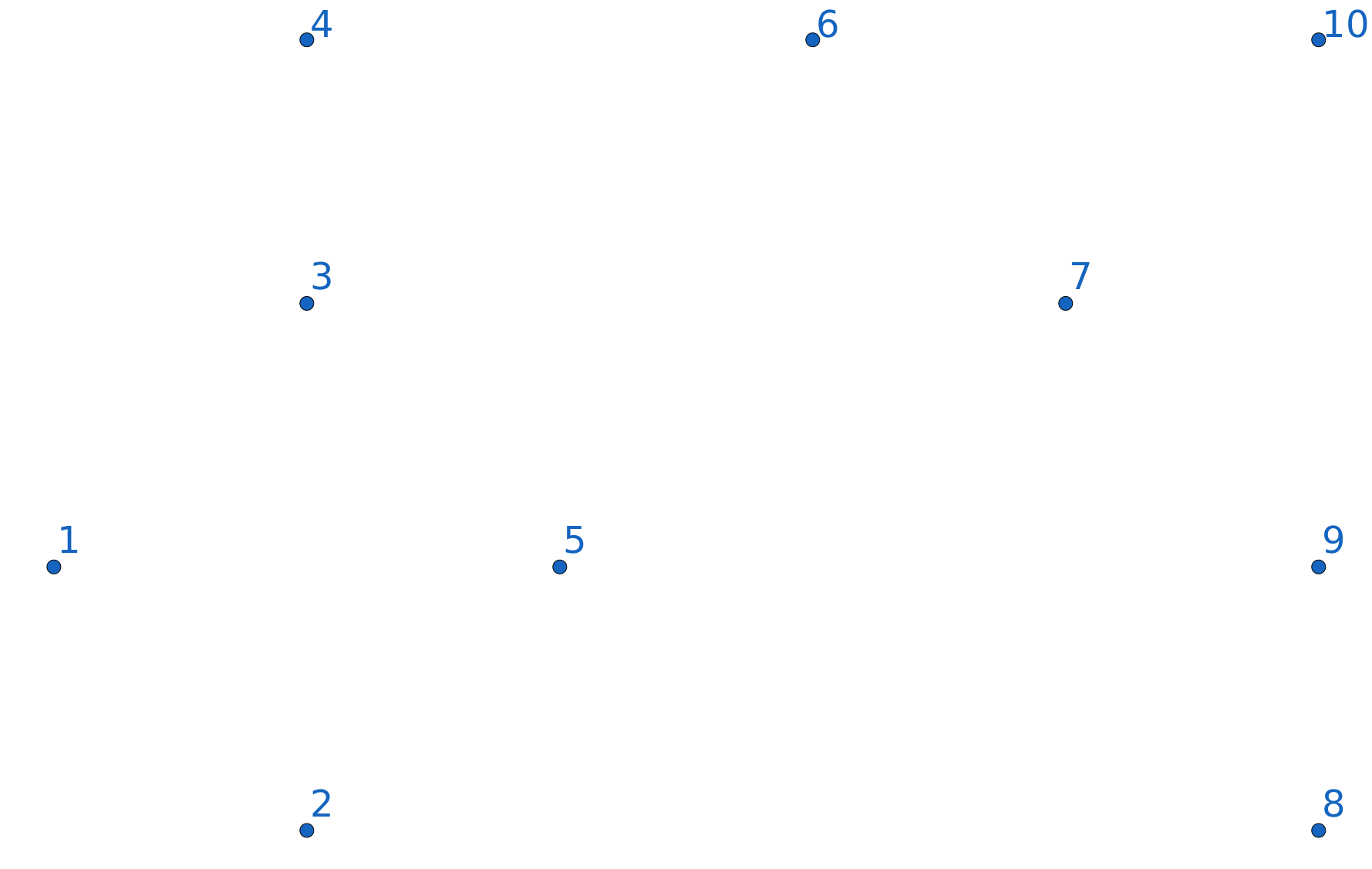
The first step of the divide-and-conquer DT construction is to sort the given point set in ascending order by \(x\)-coordinate. The figure below shows a sorted point set of size \(10\).
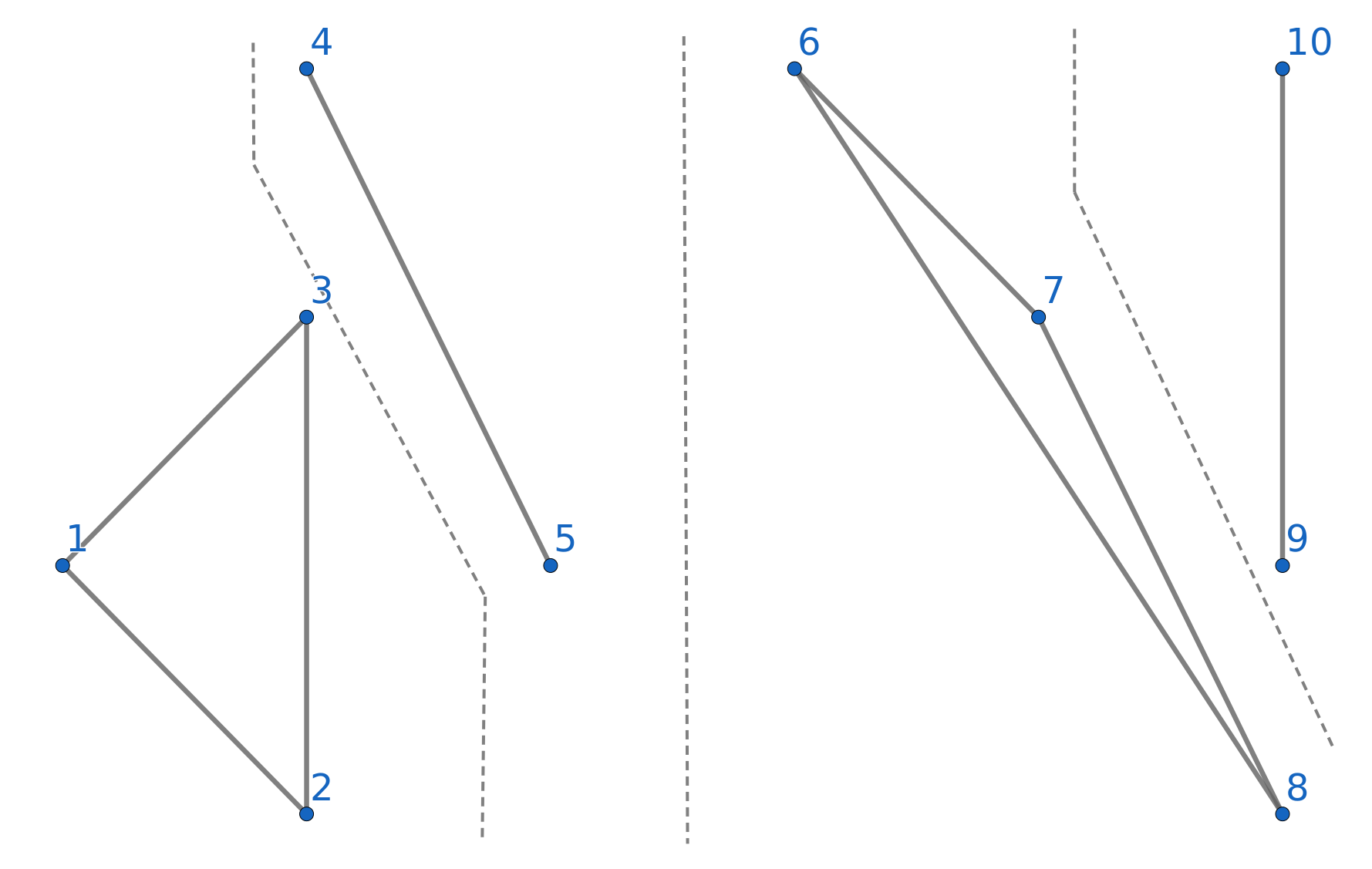
Once the point set is sorted, we can recursively split it into two parts (divide-and-conquer) until each subset contains at most \(3\) points. These subsets can then be immediately triangulated into a triangle or a line segment.
Then, during the backtracking phase of the divide-and-conquer, the already triangulated left and right subsets can be merged step by step. The merged triangulation contains LL-edges (edges from the left subset), RR-edges (edges from the right subset), and LR-edges (new edges connecting the left and right triangulations), as shown: LL-edges (gray), RR-edges (red), LR-edges (blue). To maintain the DT properties after merging, we may need to delete some LL-edges and RR-edges, but we do not add new LL-edges or RR-edges during merging.
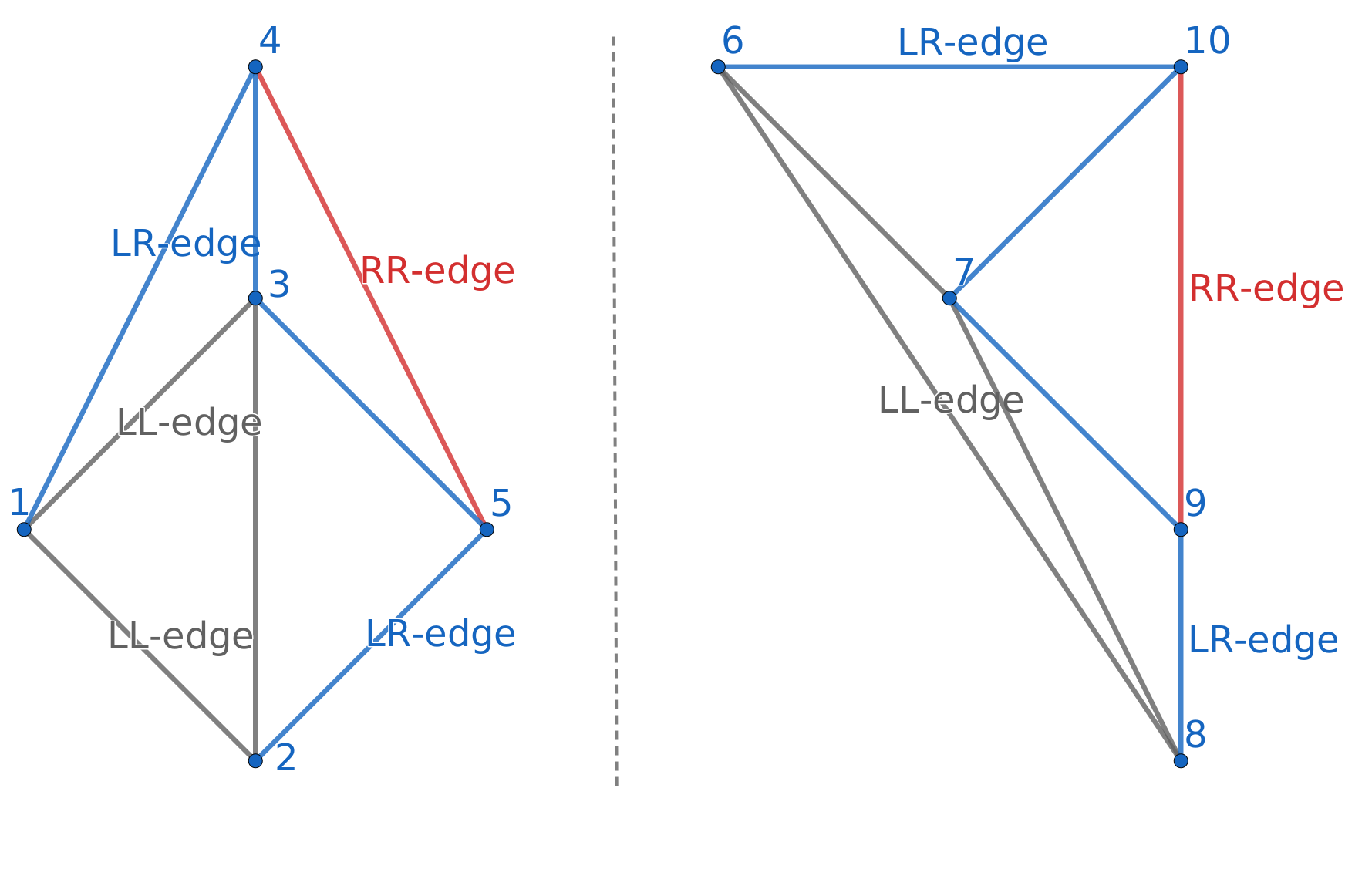
The first step in merging the left and right triangulations is to insert the base LR-edge. The base LR-edge is the lowest LR-edge that does not intersect any LL-edge or RR-edge.
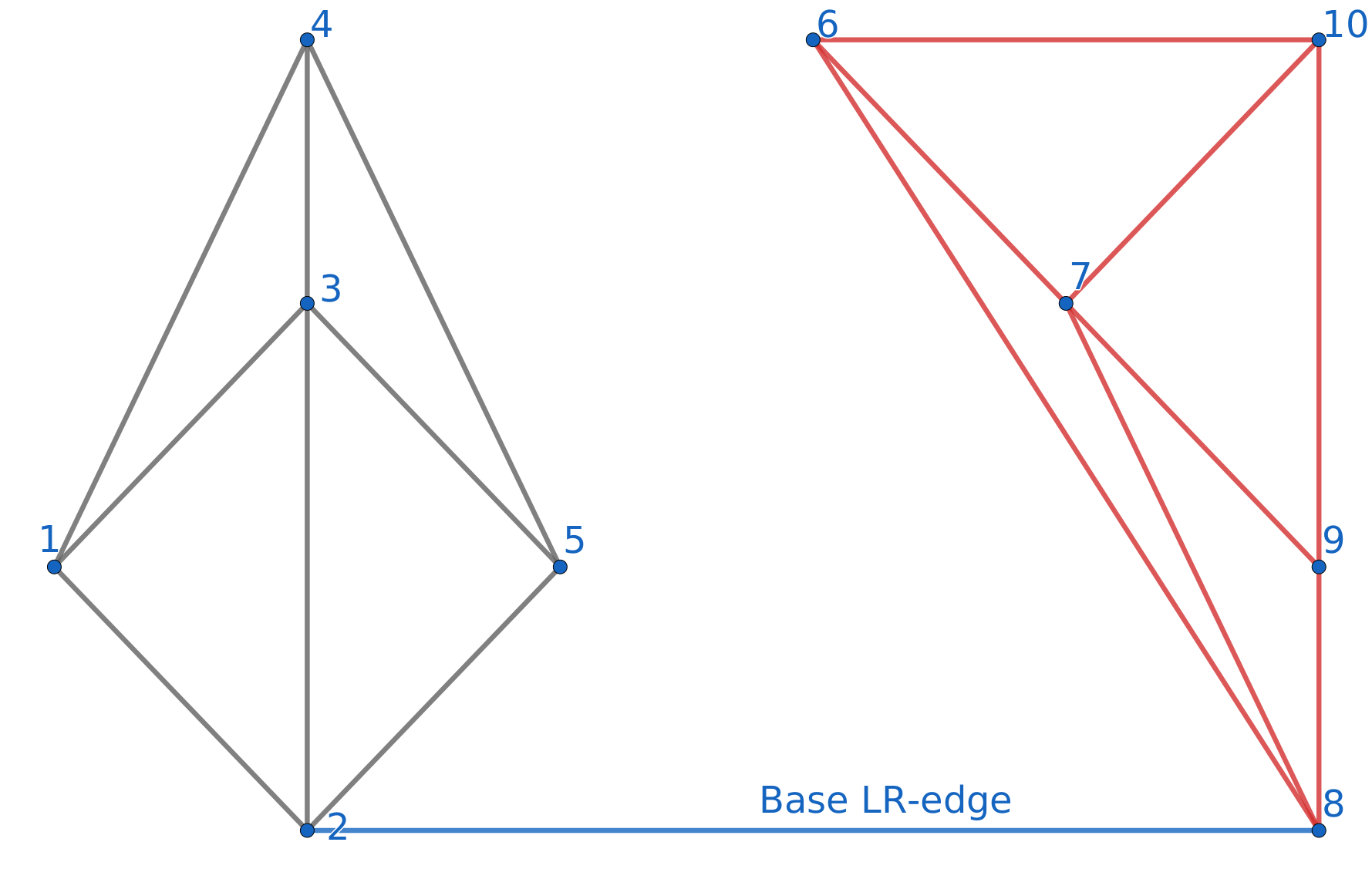
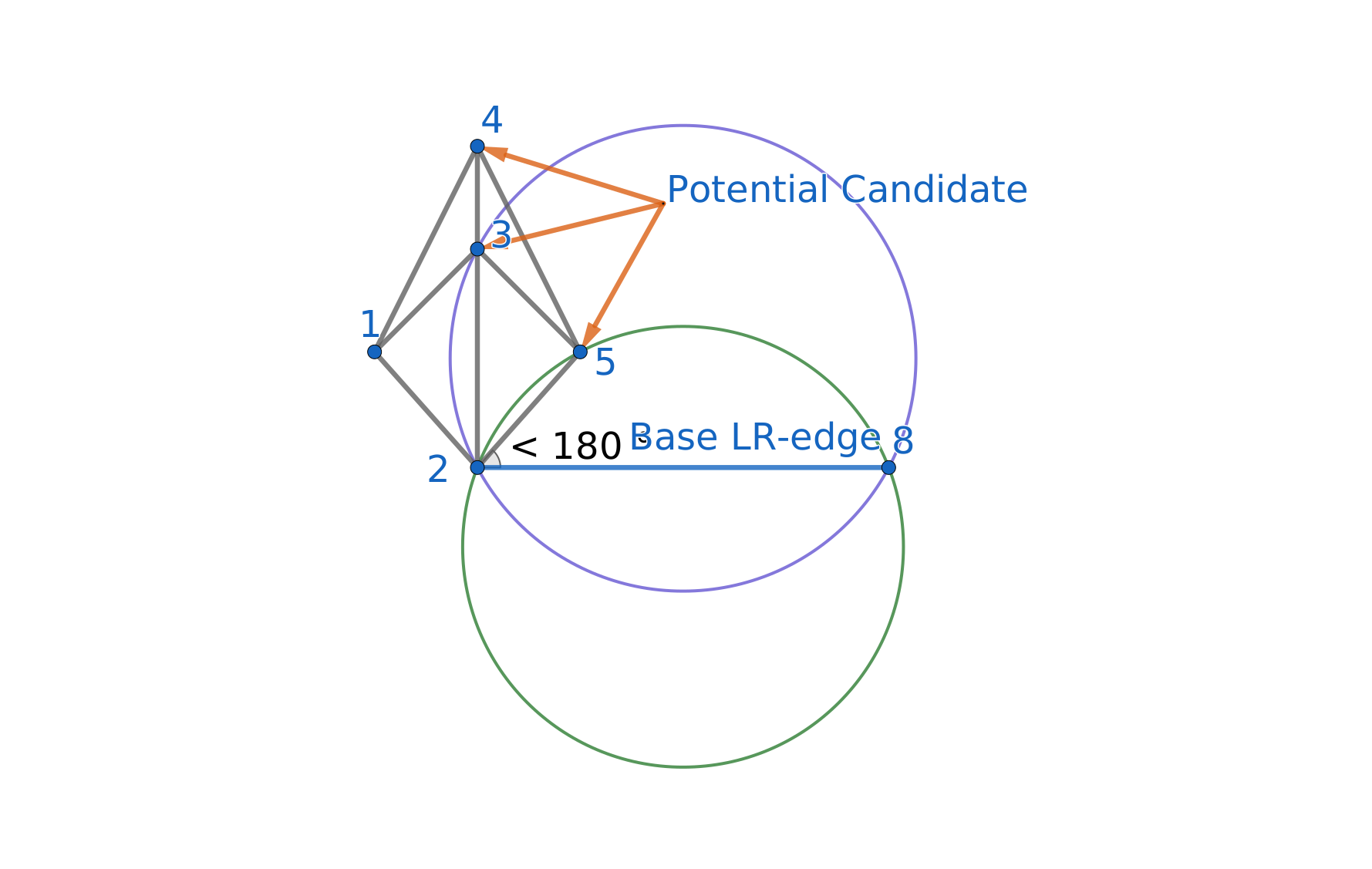
Next, we need to determine the next LR-edge immediately above the base LR-edge. For example, for the right point set, the possible endpoint (right endpoint) for the next LR-edge is the other endpoint of the RR-edge connected to the right endpoint of the base LR-edge (points \(6, 7, 9\)), and the left endpoint is point \(2\).
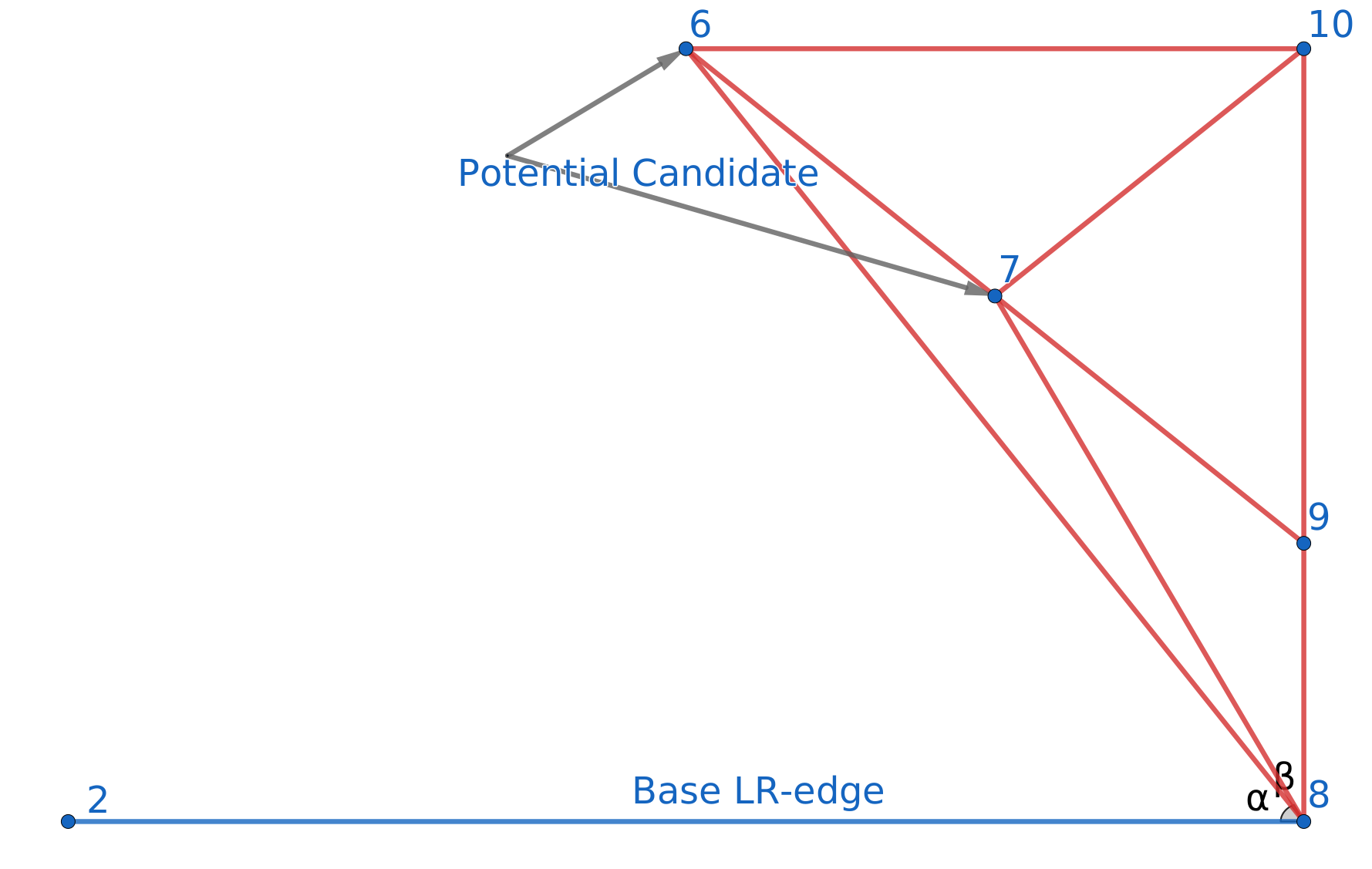
For each candidate endpoint, we need to check against the following two criteria:
- The angle between its corresponding RR-edge and the base LR-edge is less than \(180\) degrees.
- The circle defined by the two endpoints of the base LR-edge and this candidate point does not contain any other candidate points.
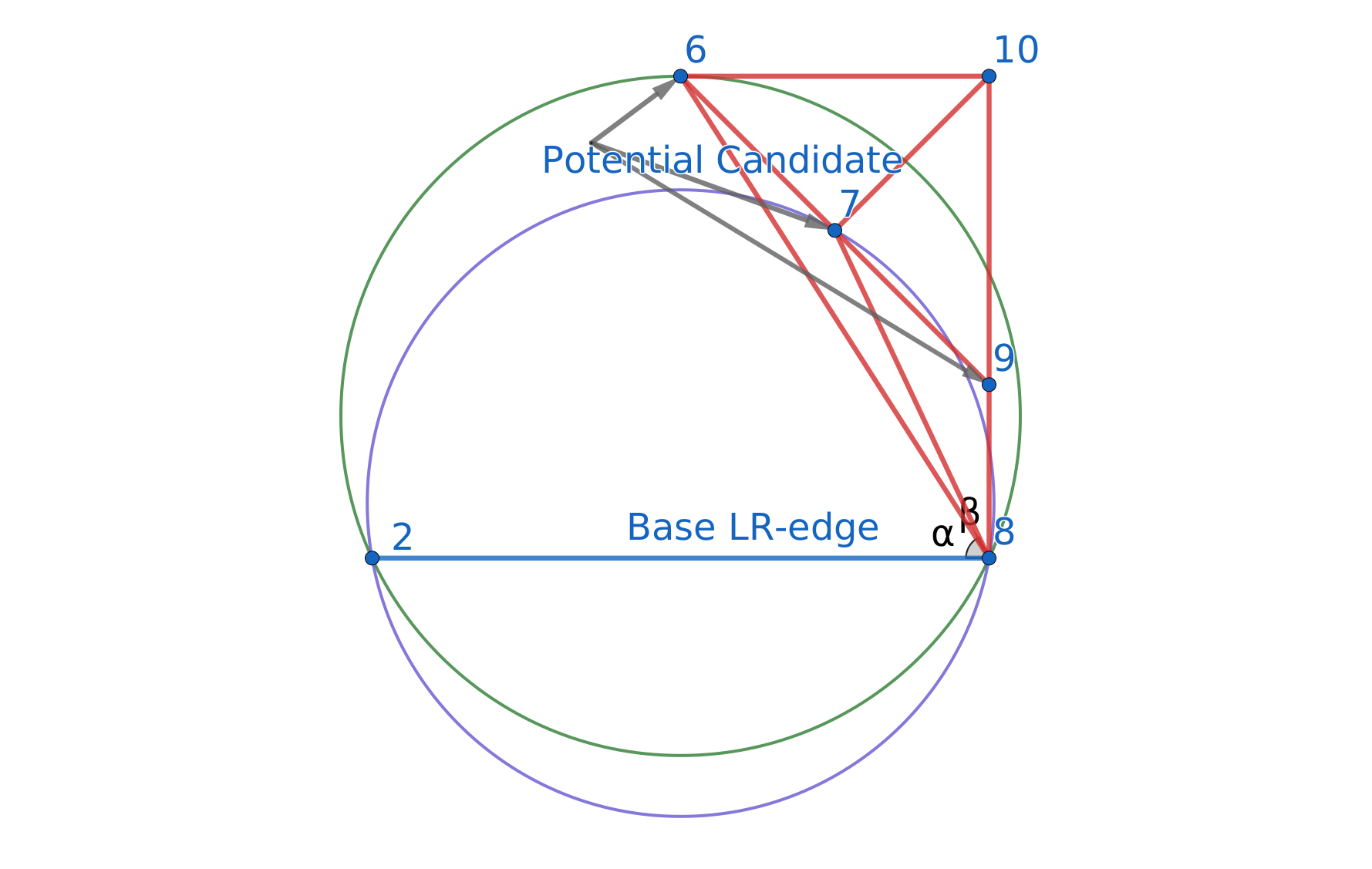
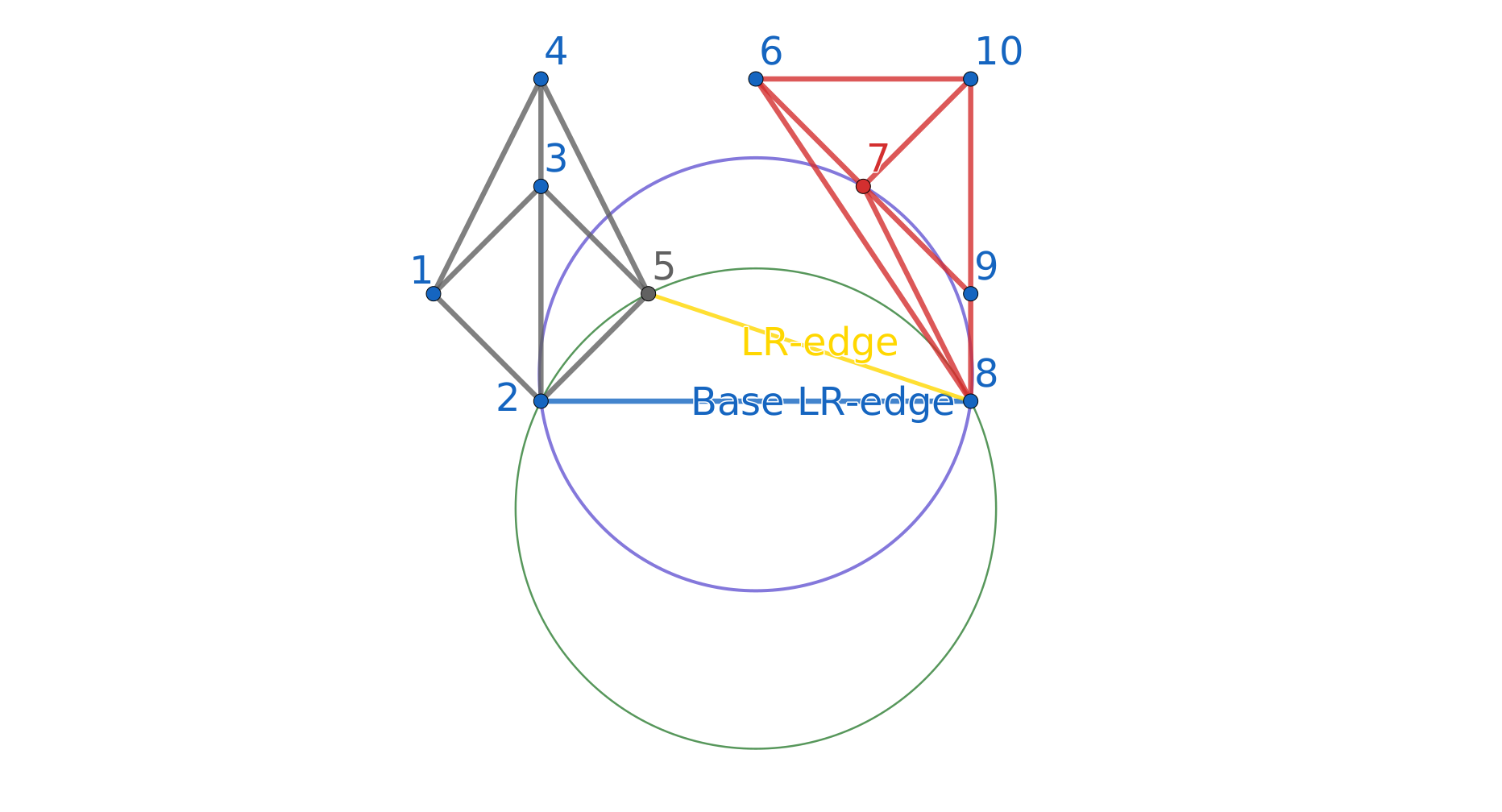
As shown above, the green circle corresponding to candidate point \(6\) contains candidate point \(9\), while the purple circle corresponding to candidate point \(7\) contains no other candidate points. Therefore, point \(7\) is the right endpoint of the next LR-edge.
For the left point set, we perform a mirror process.
When neither the left nor right point set contains any candidate points meeting the criteria, the merge is complete. When a candidate point meets the criteria, an LR-edge is added, and any LL-edges or RR-edges intersecting this new LR-edge are deleted.
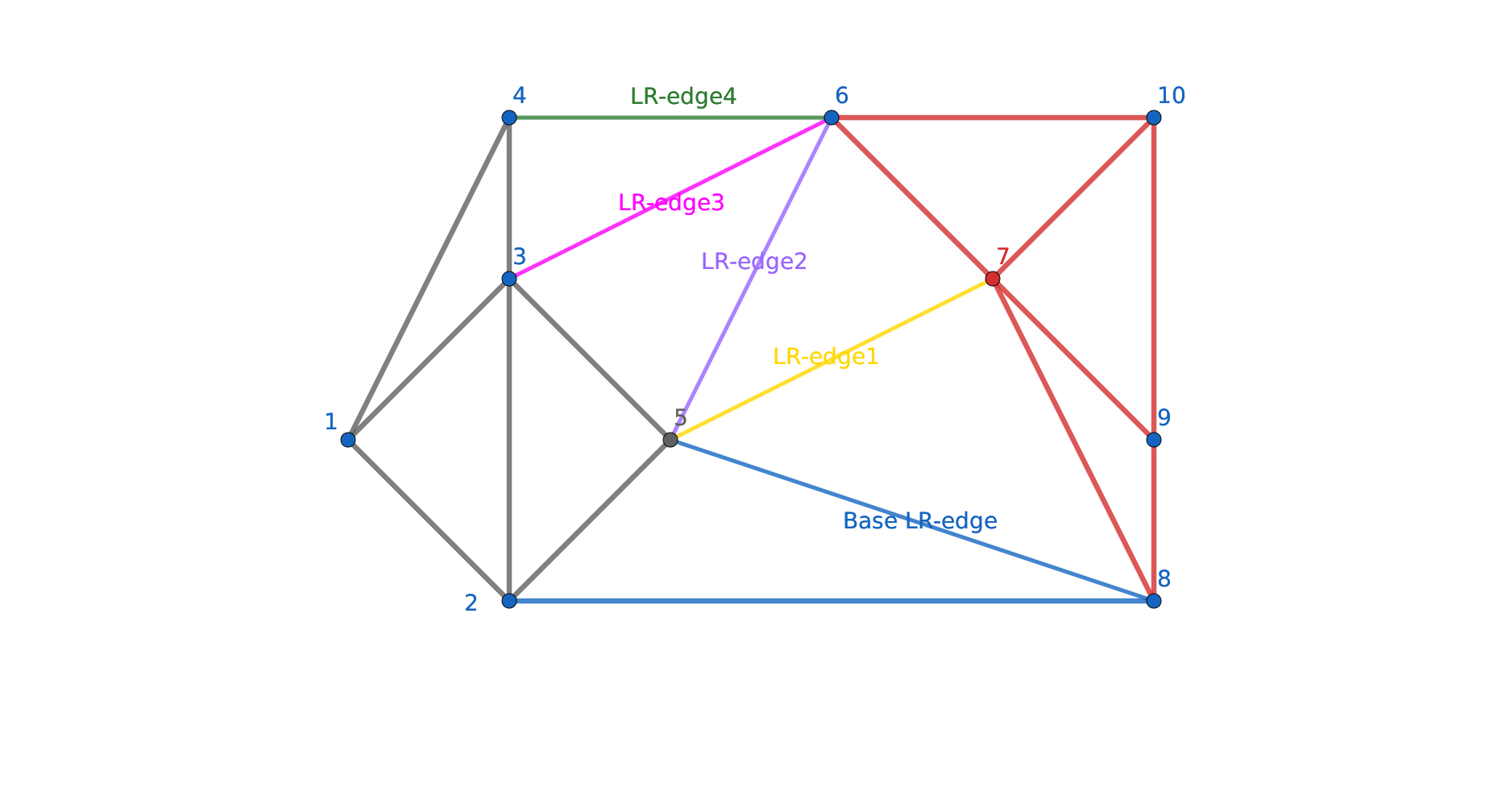
When both left and right point sets have candidate points, check if the circle defined by the left candidate point contains the right candidate point; if it does, it does not meet the criteria. The same check applies to the right candidate point. Usually, only one candidate point meets the criteria (unless four points are cocircular).
Once this LR-edge is added, it becomes the new base LR-edge, and the steps are repeated to add the next edge until the merge is complete.
Code
Implementation
1 2 3 4 5 6 7 8 9 10 11 12 13 14 15 16 17 18 19 20 21 22 23 24 25 26 27 28 29 30 31 32 33 34 35 36 37 38 39 40 41 42 43 44 45 46 47 48 49 50 51 52 53 54 55 56 57 58 59 60 61 62 63 64 65 66 67 68 69 70 71 72 73 74 75 76 77 78 79 80 81 82 83 84 85 86 87 88 89 90 91 92 93 94 95 96 97 98 99 100 101 102 103 104 105 106 107 108 109 110 111 112 113 114 115 116 117 118 119 120 121 122 123 124 125 126 127 128 129 130 131 132 133 134 135 136 137 138 139 140 141 142 143 144 145 146 147 148 149 150 151 152 153 154 155 156 157 158 159 160 161 162 163 164 165 166 167 168 169 170 171 172 173 174 175 176 177 178 179 180 181 182 183 184 185 186 187 188 189 190 | |
Voronoi Diagram
A Voronoi diagram consists of a set of continuous polygons formed by the perpendicular bisectors of lines connecting neighboring points. Given \(n\) distinct seed points in the plane, the plane is divided into \(n\) regions such that every point in a region is closer to its seed point than to any other seed point.
The Voronoi diagram is the dual graph of the Delaunay triangulation. It can be constructed in \(O(n \log n)\) time by first constructing the Delaunay triangulation using a divide-and-conquer algorithm and then applying the leftmost turn algorithm to obtain its dual graph.
Problems
SGU 383 Caravans Triangulation + Binary Lifting
ContestHunter. Endless Destruction Construct Voronoi diagram via dual graph of triangulation
Codeforces Gym 103485M. Constellation collection Graph construction after triangulation and Floodfill
References and Further Reading
- Wikipedia - Triangulation (geometry)
- Wikipedia - Delaunay triangulation
- Samuel Peterson -Computing Constrained Delaunay Triangulations in 2-D (1997-98)
本页面最近更新:,更新历史
发现错误?想一起完善? 在 GitHub 上编辑此页!
本页面贡献者:OI-wiki
本页面的全部内容在 CC BY-SA 4.0 和 SATA 协议之条款下提供,附加条款亦可能应用